
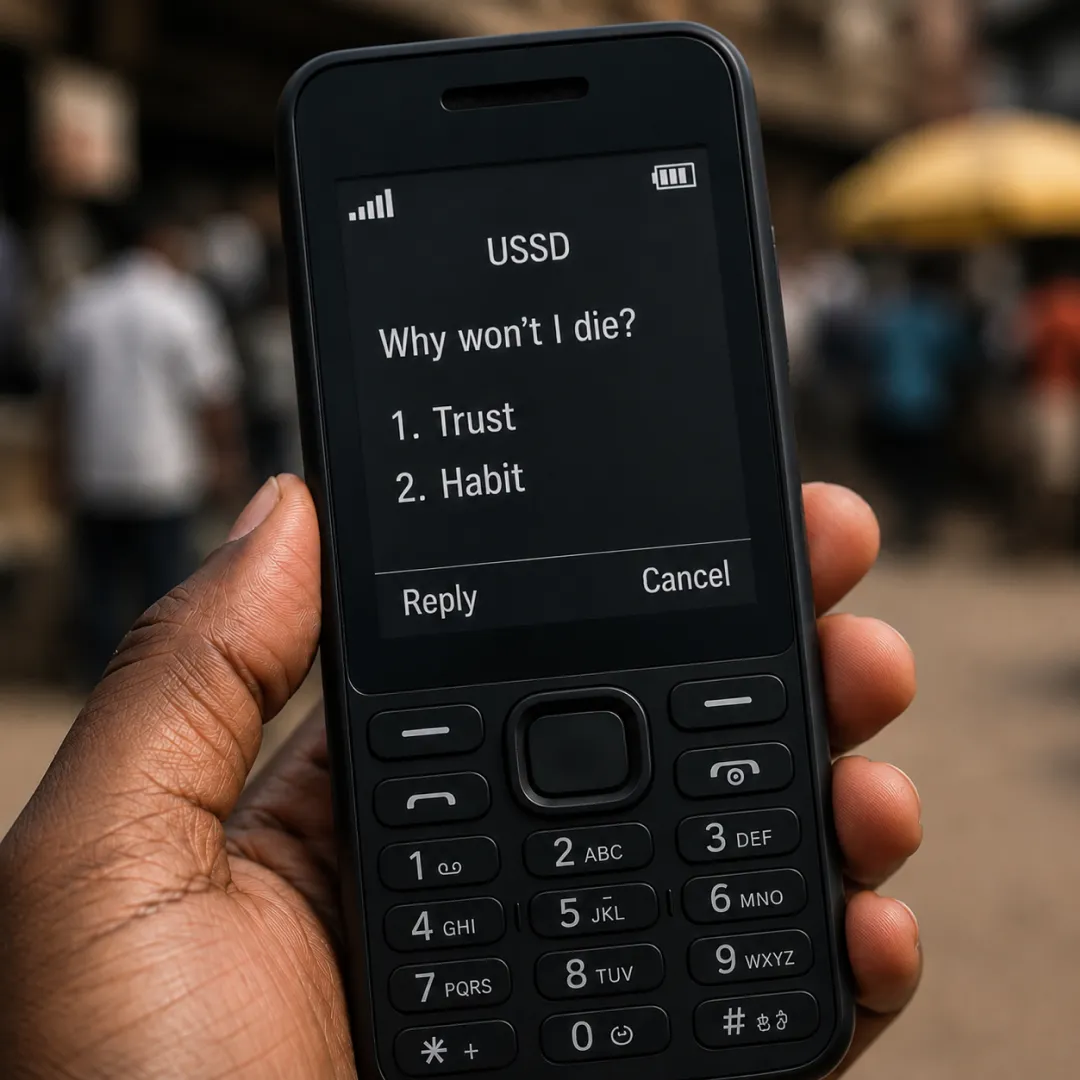
Yes. Smartphone adoption is growing, but many people still use USSD for financial services, including people who own a smartphone. It’s familiar, its cost is predictable, and it works on any phone without mobile data. Treat channel choice as a product decision based on how your customers live, not on what’s newest.
If smartphones are growing, why hasn’t USSD disappeared?
Because owning a more capable phone doesn’t mean moving to a more capable channel.
IPA’s 2025 survey of digital finance users in Kenya (opens in a new tab) found that three quarters of them used a smartphone as their main phone. Yet most of those smartphone users preferred USSD menus to apps for digital transactions. Older, poorer, rural and less educated smartphone users were the most likely to prefer USSD.
A roadmap that follows smartphone growth alone can miss how your customers actually move money.
Why do some customers prefer USSD to an app?
Because people choose financial channels on what they know, what they can access and what they feel confident using, not on capability alone.
USSD has a predictable structure. People understand the menus and know what to expect, after years of using them. An unfamiliar app may ask them to learn new conventions before they feel comfortable moving money.
Its cost is predictable too. People know what a USSD session takes from their airtime, if anything, and the charge stops when the session ends. An app’s data use is harder to read: some apps use a lot, some very little, and some keep using data in the background. We see this in our work: customers notice their data has gone without knowing which app used it, and that uncertainty becomes one more reason to doubt the app. It weighs more when people top up often. IPA’s survey found that 88% of respondents bought airtime every week.
Access matters too. The phone in someone’s hand may not run every app well. The GSMA estimates (opens in a new tab) that an entry-level internet-enabled phone costs 87% of average monthly income for the poorest 20% of people in Sub-Saharan Africa.
None of this makes USSD better in itself. It makes channel choice a product decision that has to reflect your customers’ circumstances.
Should you invest in an app or in USSD?
Often it isn’t either-or. Customers use an app for one task, USSD for another and a person when something goes wrong. Treat the app as the whole experience and you can miss where people lose clarity or confidence, which is often in the move between channels.
The essentials have to mean the same thing wherever they appear: the fee, the amount received, the status and the confirmation. A customer who switches channel shouldn’t have to relearn what a transaction costs or whether it’s complete.
Your own data can show where that breaks:
- Which tasks do customers start in one channel and finish in another?
- Do support questions rise when customers move from USSD to the app?
A question for your next roadmap review: which of your customers would you lose if the app were the only way in? It’s one of the assumptions that break in emerging markets: trust moves slower than technology.
Other questions we hear
What is USSD?
USSD (Unstructured Supplementary Service Data) is a menu-based service people reach by dialling a short code on a mobile phone. It works without mobile data or a smartphone, which is why it’s used for mobile money and banking in many African markets.
Will growing smartphone adoption make USSD disappear?
Not on its own. Owning a smartphone doesn’t guarantee affordable data, reliable connectivity or a device that runs every app well, and familiarity keeps people on channels they already trust.
Watch how your own customers behave, rather than the adoption curve.
How do you keep fees and transaction status clear across USSD and an app?
Use the same words, numbers and order for the essentials in every channel: the fee, the amount received, the status and the confirmation. A customer who switches channel shouldn’t have to relearn what a transaction costs or whether it’s complete.
Sources
- Innovations for Poverty Action (2025). Financial Consumer Protection Survey: Kenya 2025 (opens in a new tab)
- GSMA (2025). The State of Mobile Internet Connectivity 2025: Affordability of Internet-Enabled Handsets and Data (opens in a new tab)